
BepiColombo sheds solar-electric transfer module at Mercury
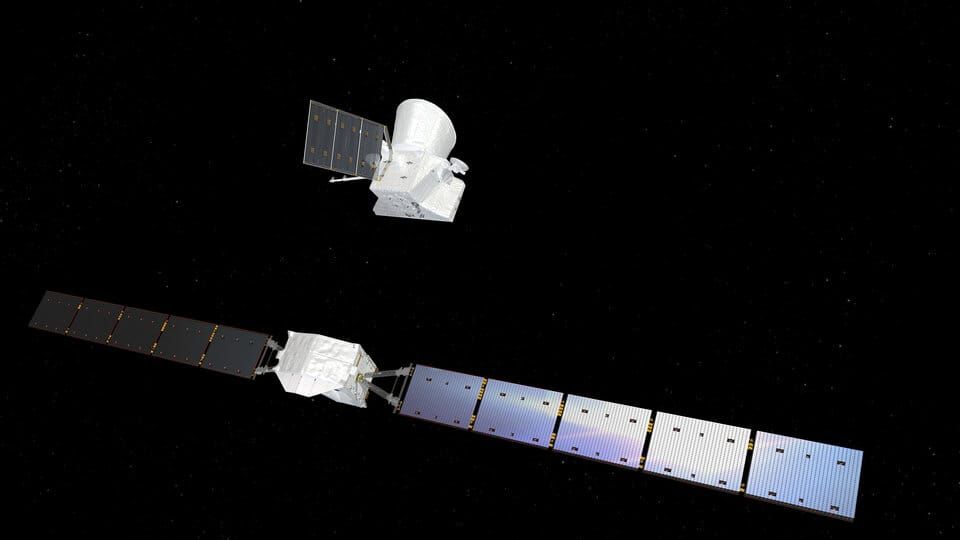
(SpaceEnergy) ESA has successfully separated BepiColombo’s solar-electric Mercury Transfer Module after its nearly eight-year interplanetary cruise, transferring propulsion and power responsibility to the mission’s Mercury Planetary Orbiter.
The Mercury Transfer Module separated from the ESA/JAXA spacecraft stack at about 13:00 BST on 3 September, more than 200m km from Earth. ESA confirmed the operation at 14:52 BST after its Cebreros and Malargüe deep-space antennas acquired signals from the spacecraft.
Telemetry showed all systems nominal following separation, with the Mercury Planetary Orbiter’s solar arrays charging the spacecraft batteries. ESA’s MPO and JAXA’s Mio science orbiter remain stacked for the final approach to Mercury.
The transfer module carried the two orbiters from Earth using solar-electric propulsion. Its ion thrusters accelerated xenon ions to about 50,000m/s, enabling the high propellant efficiency required for BepiColombo’s journey through the inner Solar System.
With the transfer stage discarded, MPO’s chemical propulsion system now controls the spacecraft trajectory. The composite spacecraft is scheduled to enter Mercury orbit on 21 November, with MPO and Mio separating on 9–10 December. Science operations are planned to begin in April 2027.
Discussion