
INTERVIEW: UK risks losing space solar power race without government backing

(SpaceEnergy) Britain risks repeating its history of pioneering technologies only to see other countries commercialise them unless the government backs space-based solar power, Conservative MP Mark Garnier told SpaceEnergy.
“The bottom line is that somebody's going to do space-based solar power,” said Garnier, who chairs the All-Party Parliamentary Group for Space, in an interview.
“The question is, do we want to be a leader or do we want to be a follower in the UK?”
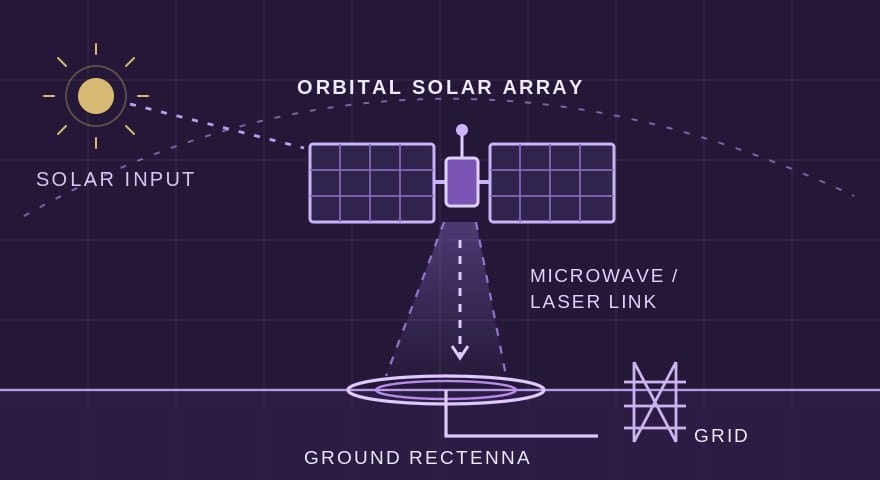
The MP said collecting solar energy in orbit and transmitting it to Earth could become a major part of the global electricity system.
But he warned Britain could repeat the experience of the jet engine, where British innovation helped to establish a technology subsequently commercialised on a much larger scale elsewhere.
The UK government has already committed up to £6 million to space-based solar power research through its innovation competition, while a government-commissioned feasibility study published in February 2026 suggested the technology could become cost-competitive by 2040.
However, its updated September 2026 Space Strategy focuses on broader space-sector investment and regulatory reform, without establishing a dedicated commercial procurement programme for orbital solar electricity.
Engineering rather than fundamental physics
Garnier, who chairs the advisory board of the Space Energy Initiative and is an Independent Non-Executive Director at UK firm Space Solar, contrasted space-based solar power with nuclear fusion, arguing that the former principally required the integration and scaling of established technologies.
“Where fusion is a physics challenge, space-based solar power is an engineering challenge,” he said, noting photovoltaic electricity generation in orbit, wireless power transmission and rocket launches all had decades of technological development behind them.
He noted also that falling launch costs, particularly those associated with SpaceX, were a major factor in improving the commercial prospects of orbital solar power.
Nevertheless, constructing a utility-scale system would present substantial challenges.
A proposed 2GW installation in geostationary orbit could require structures extending several kilometres, assembled robotically rather than simply unfolded after launch.
Government commitment could unlock investment
Garnier argued that government intervention should focus on establishing demand and sharing early development risks, rather than permanently financing the industry.
His first recommendation is a dedicated Contracts for Difference auction for space-based solar electricity, potentially beginning with a relatively small allocation.
Such an arrangement would signal that the government was prepared to purchase electricity generated by future orbital systems, providing greater confidence to private investors.
“If they created an auction for space-based solar power, it doesn't have to be very much, just a token auction,” he said.
A second priority would be public support for technology demonstrations.
Garnier estimated that developing a megawatt-scale orbital power demonstration could require investment of several hundred million pounds, making it difficult for private equity investors to finance independently.
Government participation could therefore help attract commercial capital.
“If the government comes in alongside underwriting some of that, then that certainly helps,” he said.
A global electricity market
Beyond energy security, Garnier said there was a significant commercial advantage in the ability of orbital power stations to serve customers across different geographical markets.
Unlike terrestrial electricity generators, which depend on transmission networks and interconnectors, a space-based system could potentially redirect its microwave power beam between receiving stations within its coverage area.
Garnier said this could allow operators to respond to changing electricity demand and prices across multiple countries.
“As the world's activity moves around, as the world turns around, you could be moving your beam to one of the highest spot prices that's being paid at any given time,” he said.
He also highlighted the potential to provide low-carbon electricity without the weather dependence of terrestrial wind and solar generation.
However, the commercial model remains dependent on demonstrating reliable power transmission, competitive costs and suitable ground infrastructure.
Garnier acknowledged that large orbital power stations would require international coordination but stressed that Britain should take a lead in the endeavour.
“This government right now has got a choice. Does it want to make this mistake again or does it want to be clever and work out that by seizing the opportunity and getting to understand it, you can actually be a leader in something?”
Discussion