
Surrey launches lunar-magnesium electric propulsion study
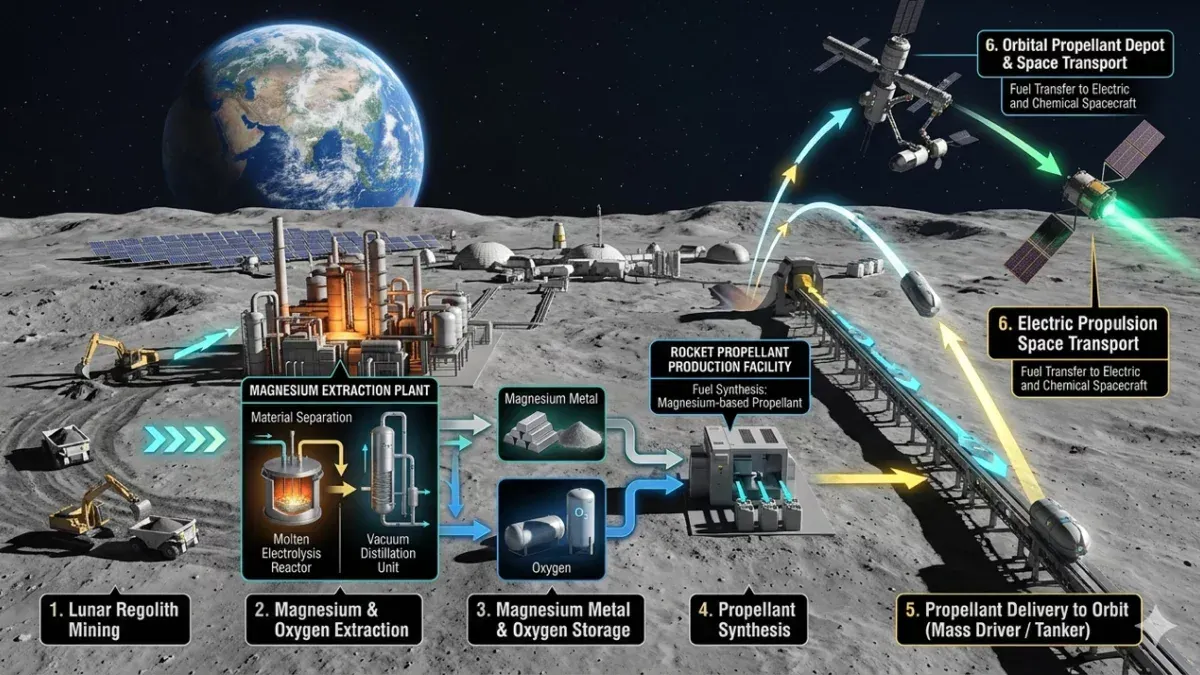
(SpaceEnergy) Surrey Space Centre has begun an ESA-funded project to determine whether magnesium extracted from lunar regolith could provide locally sourced solid propellant for electric spacecraft propulsion.
The nine-month MAGPIE project, undertaken with UK propulsion company Eos Space Technology, will investigate the chain from extracting magnesium on the Moon to feeding the metal into a novel Hall-effect thruster.
Conventional electric propulsion can use xenon or krypton transported from Earth. MAGPIE will instead assess whether useful quantities of magnesium can be recovered from different lunar regolith compositions and whether the resulting material can operate effectively despite impurities.
Researchers will develop a magnesium feed system and test thruster performance with different propellants. The work will examine challenges associated with metallic propellants including condensation, plasma instability and thruster-channel erosion.
“We will provide the first dataset grounded in actual experimentation which links lunar extraction pathways to a functional thruster architecture,” Eos Space chief executive and co-founder Szymon Dworski said.
The project runs from September 2026 to May 2027 and has received £112,795 through the European Space Agency's Open Space Innovation Platform.
The partners said the work is intended to establish a feasibility envelope for metallic-propellant electric propulsion rather than demonstrate that lunar magnesium is already a viable operational propellant.
If technically feasible, locally sourced magnesium could reduce dependence on propellant launched from Earth for future lunar mobility, cislunar logistics and deep-space missions.
Discussion