
Shenzhou-24 docks with Tiangong to test chemical-electric propulsion
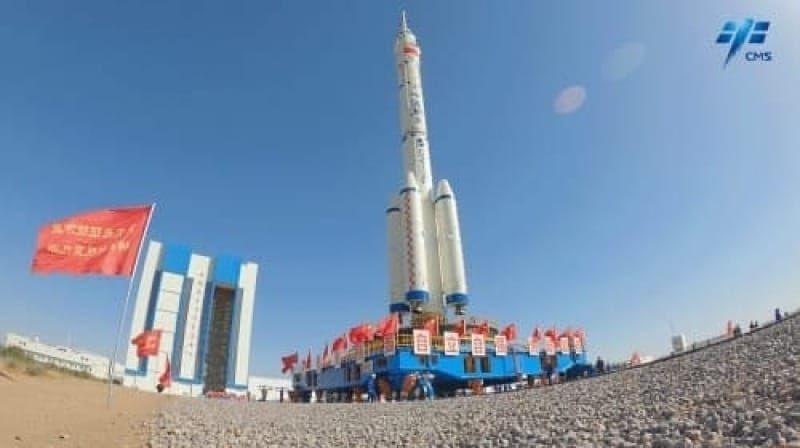
(SpaceEnergy) China’s Shenzhou-24 crew has reached the Tiangong space station, beginning a mission that will include key tests of a hybrid chemical-electric propulsion system using a new ionic-liquid propellant.
A Long March 2F Y24 rocket launched Shenzhou-24 from the Jiuquan Satellite Launch Center at 08:18 Beijing time on 25 November 2026 (00:18 GMT), according to the China Manned Space Agency (CMSA). The spacecraft docked autonomously with the forward port of the Tianhe core module at 11:56 Beijing time, and the crew entered the station at 14:35.
The crew comprises commander Tang Hongbo, Wu Yi and an astronaut from Pakistan, the first foreign astronaut to visit the station. Their tasks include an in-orbit handover with the Shenzhou-23 crew, station maintenance and inspections, and space science and technology experiments.
At a press conference on 24 November, CMSA said that in aerospace technology the mission would focus on key technology tests of a multi-mode hybrid chemical-electric propulsion system based on a new ionic-liquid propellant, as part of work on new spacecraft power technology. CMSA did not give performance figures or a test schedule.
CMSA also said the outgoing Shenzhou-23 crew had built China’s first in-orbit verification platform for new energy-storage batteries and completed in-orbit verification of the first semi-solid-state batteries. The agency said this laid technical groundwork for upgrading the energy systems of the space station and China’s lunar exploration programme. During a spacewalk, Shenzhou-23 astronauts Zhu Yangzhu and Zhang Zhiyuan also repaired a solar array.
The propulsion tests are planned and no results have yet been reported.
Discussion